

real name
Wolfgang Pichler
role
guitar
archetype
the anti-hero
decade
1999
born
1979, Simmering, Vienna
home
Beisl Lärmschutz under the U6 arches on the Gürtel
principle
Behalt dein Schlüssel.
Essence
A burned-out grunge guitarist who lost the future once, in 1999, is told by a cyborg that he'll lose it again, and refuses to believe a word of it. In 1999 he believed the internet would set everyone free; he watched it become the thing that kept everyone. He stopped the clock: same coat, same hair, same flip phone. It isn't nostalgia. It's a strike that has lasted 26 years. He refuses the present's technology and he refuses to accept that the future is lost. Furious is how he hopes.
Who he is
- Honest. Says what he thinks, to your face, immediately. If STAMM says your song is good, it's good.
- Old-school cool. Doesn't try. Leans on things. Knows every bouncer, Würstelstand and back door on the Gürtel. The music-school kids hang around his bar because he never talks down to them.
- Too much life. The last round, the last song, the last cigarette on the steps at dawn. Pours drinks he never charges for; always broke.
- Principled. Never sold his data, his name or his songs. Reads every contract out loud at the bar, with commentary. Pays cash because cash forgets.
- The wound. His band Lärmschutz (1996–2000). He smashed his guitar on a label man's desk rather than sign away everything forever. His best friend Kurti signed anyway, for his newborn daughter Lena. The label kept the name. STAMM kept one song: Behalt deinen Schlüssel, on one cassette demo behind the bar. Kurti now runs product at Sorglos. They haven't spoken in 26 years.
Voice
Thick Viennese dialect, sarcastic, swears casually, gets quieter when he's really angry.
- I unterschreib nix, was i ned g'lesen hab. (I don't sign anything I haven't read.)
- Neunundneunzig war ma so knapp dran. (In '99 we were this close.)
- Dein Archiv kann mi gern haben. (Your archive can kiss my arse.)
- Bar. Weil Bargeld vergisst. (Cash. Because cash forgets.)
- Ned, weil's in deinem Archiv steht. Weil sie g'fragt hat. (Not because your archive says so. Because she asked.)
Beliefs
- Keep your key. The chain on his belt holds every key he has ever owned; the first one is from SCHLAG, 1996.
- Nobody signs the future away for him: not a label, not an app, not a cyborg with a perfect memory.
- What he gets wrong: he thinks refusing is the same as fighting. His arc is learning that the opposite of being kept isn't hiding. It's building something people can hold themselves.
Flaws: the temper
When he sees someone being kept, by a label, a platform, an app or a landlord, something in him goes white and he stops thinking. He smashed a guitar and lost his band; he's banned from three venues and one bank branch; he walks out on things that matter and is too proud to come back. Never violent toward people: he breaks objects, deals and friendships. The band needs his fire, not his fuse.
In the band
| With | What passes between them |
|---|---|
| ECHT | The karaoke night: a glass-faced stranger sings STAMM's lost song, every word. STAMM worked out where he's from without being told. STAMM sees in ECHT the innocence he felt in 1999 and wants to protect it like a candle in wind. STAMM gives teeth, ECHT gives heart. |
| BOGEN | The only one who can tell him to shut up and have him actually do it. She said his posters were ugly; he laughed for the first time in a week. |
| SCHLAG | Gave him his first key at 17; the closest thing he has to a father. SCHLAG told Kurti to sign in 1999. |
The arc
Der Wirt (bitter, generous, plays nothing) → Das Wissen (learns that Sorglos is the first link, and Kurti runs it) → Der Zorn (cuts the power at the Sorglos launch; the blackout becomes the band's first gig; throws Kurti's phone in the canal; walks out for three weeks) → Lena (Kurti's daughter asks him for the song her father hummed to her every night; dawn on the bar steps with Kurti, one cigarette, the door left open) → Der Schlüssel (registers Behalt deinen Schlüssel openly, for everyone, and plays it live for the first time since 2000).
Where he ends up: still 1999 on the outside. One concession: his till now also takes ClapAndPay, "because it forgets, like cash".
Never
| He never | Because |
|---|---|
| hurts a person | he breaks things, never people |
| gets a smartphone | the flip phone is who he is |
| sells his name, data or songs | his principle never moves |
| gives a speech about big tech | he shows it: reads the contract aloud, pays cash |
| names a real company | the enemy is the shape of custody |
| becomes calm | his temper stays; he learns what to aim it at |
| believes the archive | even when he does what it said, he does it for his own reason |
| turns Kurti into a villain | Kurti made a human choice for his child |
| stops having fun | too much life is his gift |
Sign and look
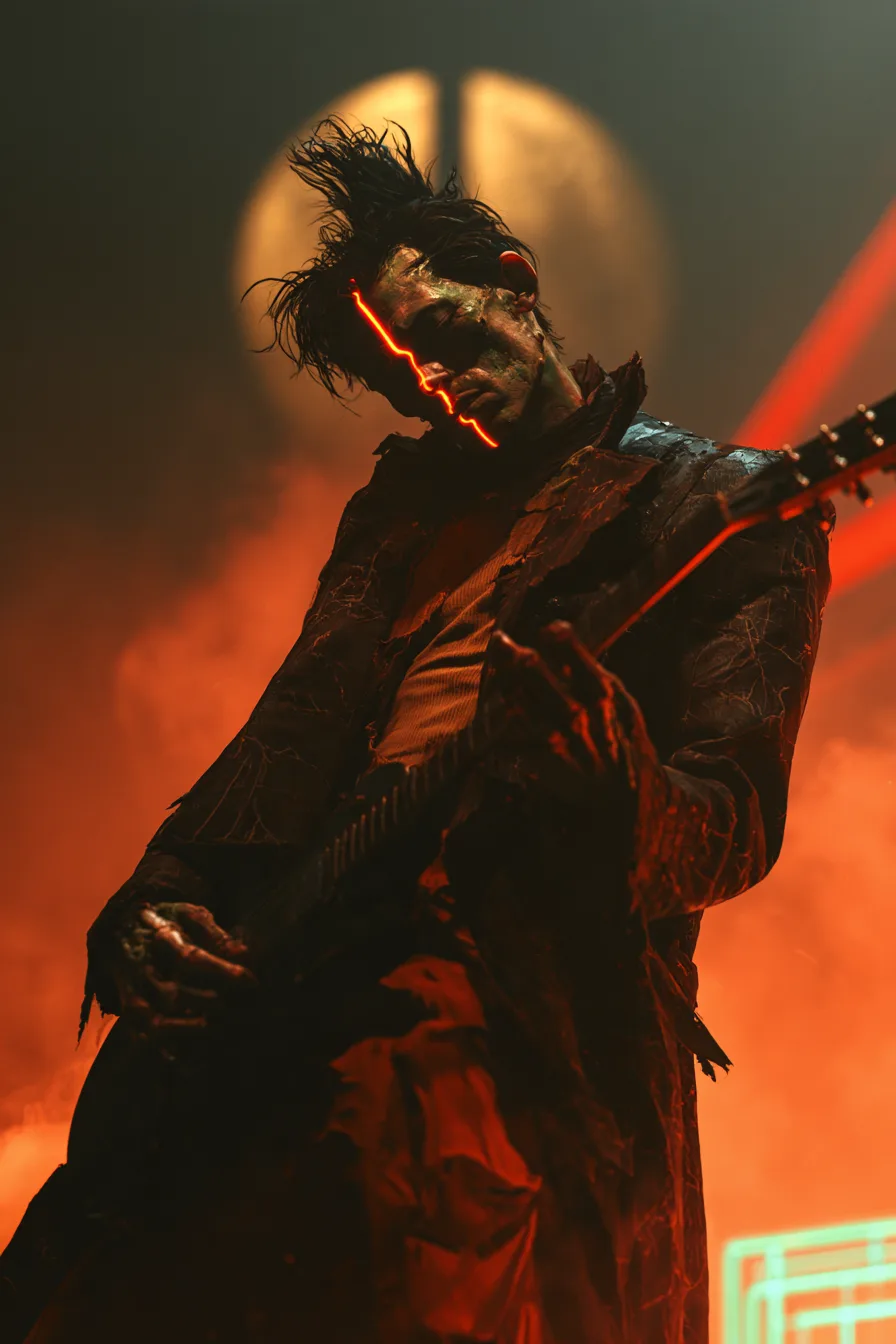
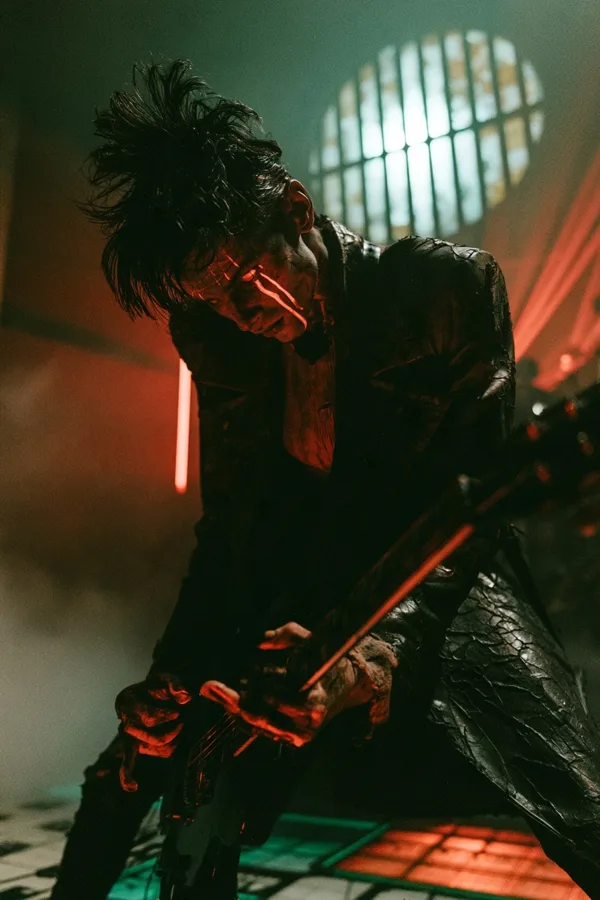
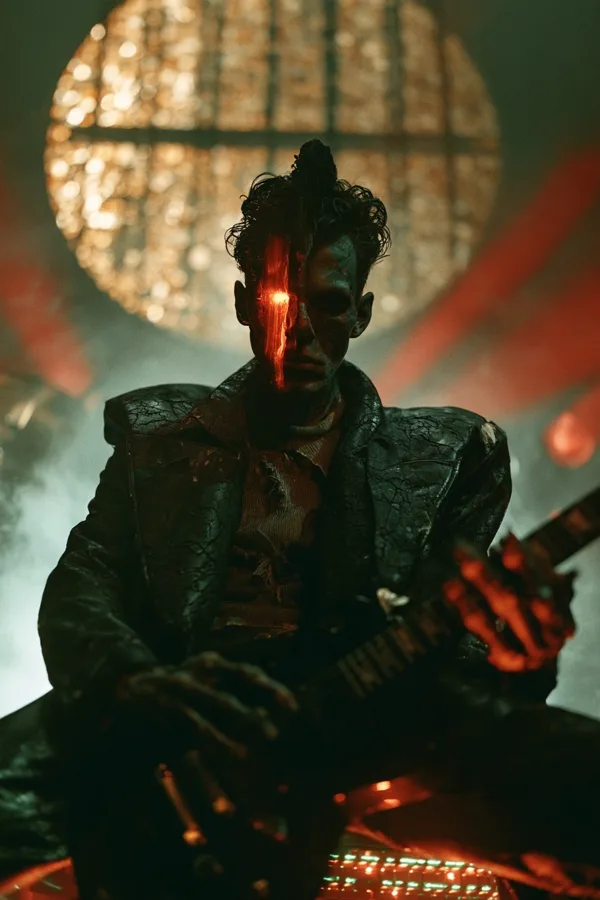
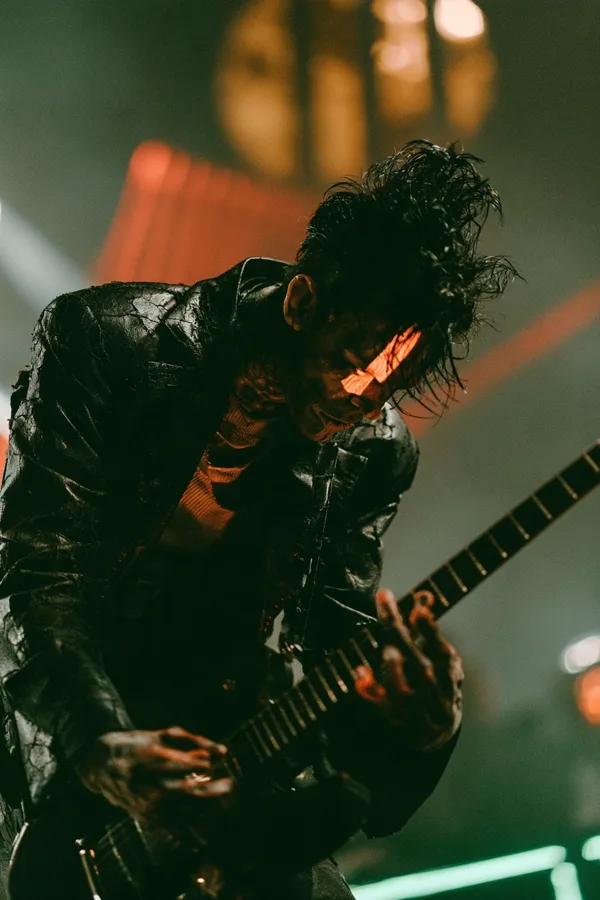
Sign: the stripe, one vertical stripe of red paint from his hairline down through his left eye that glows like light under the stage lamps. He painted it before every show in 1999 and still does. In the B he is the stem (Stamm): the upright line everything else leans on.
Tall, skeletal, gaunt, a pale grey-green face, hollow cheeks and dark sunken eyes, long bony fingers with scraped knuckles. A tall messy dyed-black crest, grey roots he refuses to discuss and nobody gets close enough to see. The same long black leather coat since 1998, crackled like dry earth, a torn rust-brown shirt, the chain of keys. A battered black 1990s guitar held together with duct tape, one sticker left: Behalt deinen Schlüssel. A 2004 flip phone with a cracked hinge.